

One of the Blood Services staff members who was not in Israel on October 7th was Ruslan Rosenblatt from Beersheba.
That weekend, he was vacationing with his family in France. As news began to arrive from Israel, it was clear to him that he wanted to return and join his colleagues in the Southern Blood Drive Team.
The family left their vacation and began the journey back from the Alps to Paris and from there to Greece, but flights to Israel were canceled.
“I was restless,” Ruslan said. “We saw what was happening in Israel; it was truly terrifying. Although the airline arranged for us to stay in hotels, I couldn’t stay. It was clear to me that I had to return to Israel and help my friends with the Magen David Adom blood drives.”
After four days, he managed to join a rescue flight. His family remained in Greece, and Ruslan boarded a military Hercules aircraft along with young people who had received emergency call-up orders.
He arrived in Israel in the early morning hours of October 12th.
“There was only police on the roads; it was completely empty. On the way, I was caught in several sirens; I saw interceptions over my head. I realized I had come to a war, but I didn’t regret returning.”
For Ruslan, the events were also very personal.
In normal times, his blood drive team used to visit Kibbutz Be’eri and other kibbutzim in the area every three months. The blood drive in Be’eri was held in the dining hall. Each donor lay on the bed for about fifteen minutes, and during that time, conversations and personal connections were formed.
After October 7th, when Ruslan saw the photos of those murdered in Be’eri, he said he recognized almost every second person.
Alon Barad of blessed memory, the husband of one of his teammates for ten years, was also murdered.
“I had to come and contribute with what I know how to do best,” he said.
Ruslan and his team were stationed at blood drives in central Israel, including at Beilinson Hospital.
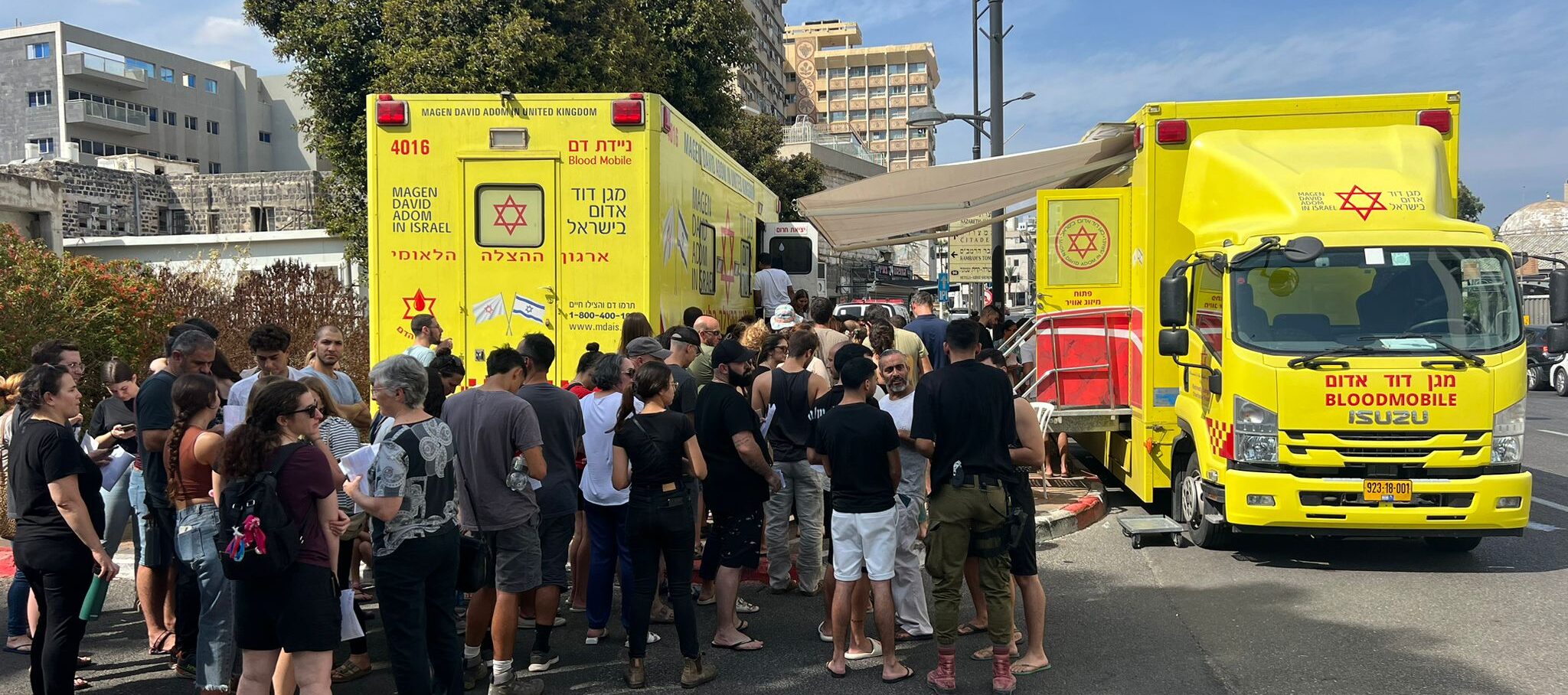
On routine days, the team used to collect up to a hundred units at a site. In those days, they collected about 500 units each time.
Work lasted about 14 hours a day.
“So many people passed through my hands; every day I heard heartbreaking stories,” he said. “With every unit of blood I held in my hand, I thought about where it would go, whose life it would save.”
And alongside the pain, the public’s response was also etched in his memory.
“It is not to be taken for granted—to go out during sirens, in fear, in war, to stand in line, in exemplary silence, not to receive something but to give. It is moving, and this is our hope, this solidarity.”

Lior Rothschild, a Magen David Adom Blood Services employee in the south, also remembers that morning well.
At 8:30 AM, the two southern blood drive teams were called up.
“They told us to pack suitcases because we wouldn’t be returning home during the first week,” he said.
And indeed, they did not return. Lior only reached his home on the following Friday.
“On the first day, we collected more than 700 units of blood. It was insane. I hardly slept during that week, but it wasn’t for nothing.” During those days, he heard about a Givati officer who received whole blood right in the field and whose life was saved.
“It’s a satisfaction beyond words,” he said.
One of the moments etched in his memory occurred during a blood drive in Modi’in Illit. Hundreds of people from the Haredi community came to donate.
Lior worked continuously. When he looked up for a moment, he saw the donors standing for the Mincha prayer. A while later, he looked up again, and this time they were already praying Maariv.
“The logistics in such a blood drive operation are complicated,” he said. “In every city we arrived at, Magen David Adom men and women welcomed us and took care of us. It felt good to meet and get to know one another, everyone together, in a shared destiny, under the same flag, for the same mission.”
And he especially remembers the donors.