




The Simchat Torah 5784 of Magen David Adom paramedic Yedid Shochat began like any Shabbat and holiday for a religious family in the Gaza envelope, until within minutes, nothing about it was normal anymore.
At 06:29, the siren sounded in Moshav Patish. Raz, Yedid’s wife, woke him, and the two gathered the children and went with them into the safe room. The sirens continued, one after another.
At a certain point, Raz stepped out of the safe room for a moment to brush her teeth and heard an unusual noise from outside. “What is that noise?” she asked Yedid. He stopped and listened, but at that moment, he heard nothing more. Neither of them suspected it was gunfire.
At 07:22, the phone rang.
Yedid observes Shabbat. The mere ringing of the phone already indicated that something was amiss. On Shabbat, he is only called for a medical emergency. On the line was Liz from the Magen David Adom dispatch center. She reported that his friend and colleague, Peter Lesnik, a Magen David Adom ambulance driver, had been shot and wounded near the Urim Junction, and asked if he could go out and replace him.
Yedid did not think twice and replied, “Of course I’ll come.” Within minutes, he was dressed and ready to leave. He called his brother Hagai and asked him to come with his wife to their home and stay with Raz and the children due to the unusual sirens and rocket fire. He estimated he would return home within a few hours.
When his brother arrived, Yedid left. Another siren caught him at the entrance to his home, near the car. He lay down next to a concrete wall and waited. When the siren ended, a burst of gunfire was heard. Only then did he realize that this was also the noise Raz had heard earlier from inside the house. He got up, ran to the car, and then another siren sounded.
Again, he lay on the ground. When it ended, he got into the car, took his pistol from its holster, and placed it within reach.
He called Peter, the intensive care ambulance driver who had been shot, but Peter did not answer. Yedid drove quickly to the Urim Junction, looking for the yellow intensive care ambulance. He remembers cars and people, but parts of the scene remained blurred for him.
He later described it as a kind of “tunnel vision.” Only later did he realize that at those very moments, he was driving through an area where terrorists were passing and shooting at people on the roads.
When he managed to speak with paramedic Dani Starkman, it became clear that Peter had already been evacuated from the area and the team was on its way to rendezvous at the Gilat Junction. Yedid rushed there, but by the time he arrived, Peter had already been transferred to another ambulance. He joined Dani, and the two returned to the Magen David Adom station in Ofakim, where a casualty treatment site had been established.
A private car quickly entered the station with two wounded individuals inside. One of them had lost his pulse. The team began resuscitation, but it soon became clear that there was no longer any possibility of saving him. The second wounded person was treated and evacuated to the hospital under the incessant sirens.
Not long after, another vehicle arrived with four gunshot victims inside, soldiers and civilians. Yedid and Linoy Weitzman loaded them into the ambulance. Just before leaving, Dani stopped them: there was another wounded person, a police officer shot in the leg. They also loaded him.
The police officer sat next to Linoy, who was holding the steering wheel, with the window open and his weapon drawn to secure the ambulance on the way. Behind, Yedid remained alone with several gunshot victims.
On the drive to Soroka, he moved from one to another, quickly checking their condition, stopping bleeding, checking tourniquets, and replacing them as needed. Amidst the crowding, the sirens, and the knowledge that gunfire was still ongoing outside, he also tried to talk to the wounded and calm them. “Perhaps myself too,” he later recounted.
At Soroka, preparations had already been made to receive the casualties. The team delivered the five wounded, restocked, and returned to Ofakim. From there, the day continued with a continuous sequence of treating and evacuating casualties.
Together with medic Sharon Im Shalom and volunteer medics Israel Novik and Shalem Avigzar. He assisted at the treatment site at the Ofakim station, and afterwards they were dispatched to treat a police officer who was seriously wounded by gunfire. They treated him and evacuated him to Soroka. Afterwards, they continued to rendezvous with IDF forces and other teams and to treat wounded soldiers from the combat zones and civilians from the communities.
Throughout all those hours, two worlds coexisted for Yedid.
In one world, he was a paramedic. He treated the wounded, went out on evacuations, heard gunfire and sirens, and tried to understand where it was safe to drive. In the other world, he was a father and husband, whose family was at home in Patish, within that same sector.
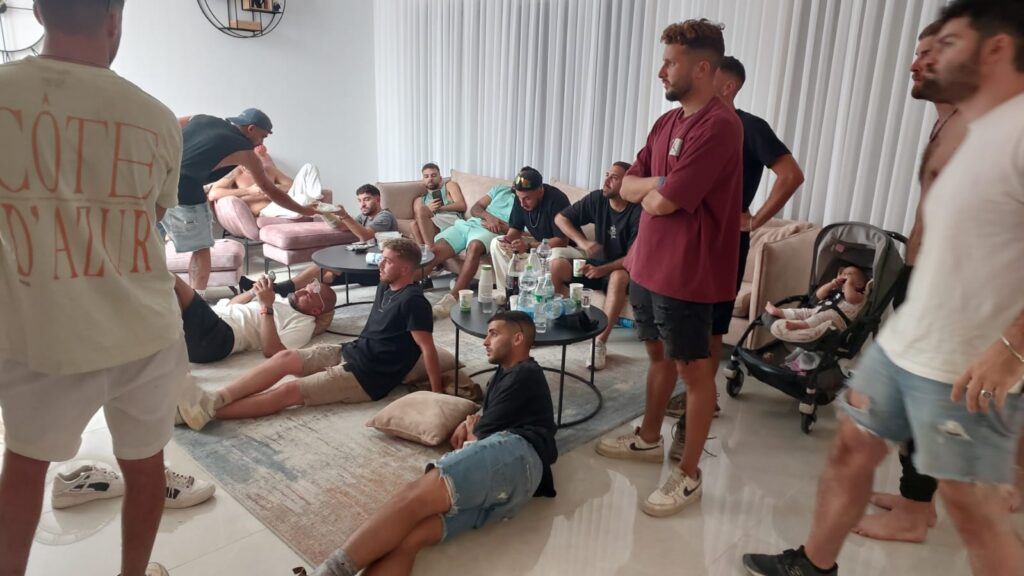
In one of the messages, Raz sent him a picture from inside their home; the house was filled with survivors of the Nova party who had fled the massacre and arrived in Patish. “There are millions of people here who fled a party,” she wrote to him. Yedid replied warmly and returned to work. Later, a woman called him, seeking a way to help her brother, who had fled the party and was on his way to Patish. Yedid tried to guide him by phone to the moshav and sent him a location. As more and more calls began to reach him while he was treating the wounded, he directed them to Raz and his brother Hagai, who remained in the moshav and could assist.
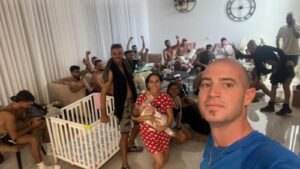
His brother Hagai, who had recently completed a medic course at Magen David Adom, also began treating gunshot victims and party survivors who arrived in Patish.
Yedid later recounted that throughout the day, he repeatedly promised Raz and his mother that he was staying at the Magen David Adom station and not leaving it. This was not the truth. He continued to go out to treat and evacuate casualties across the sector. From his perspective, these were lies intended to allow them to get through those hours, while he continued to do his job.
Only in retrospect did he realize how close he himself had been to danger. The road he took that morning to the Urim Junction was, at those very minutes, a scene of massacre. Terrorists had passed along the route, shooting at travelers and continuing towards Ofakim and the Urim base.